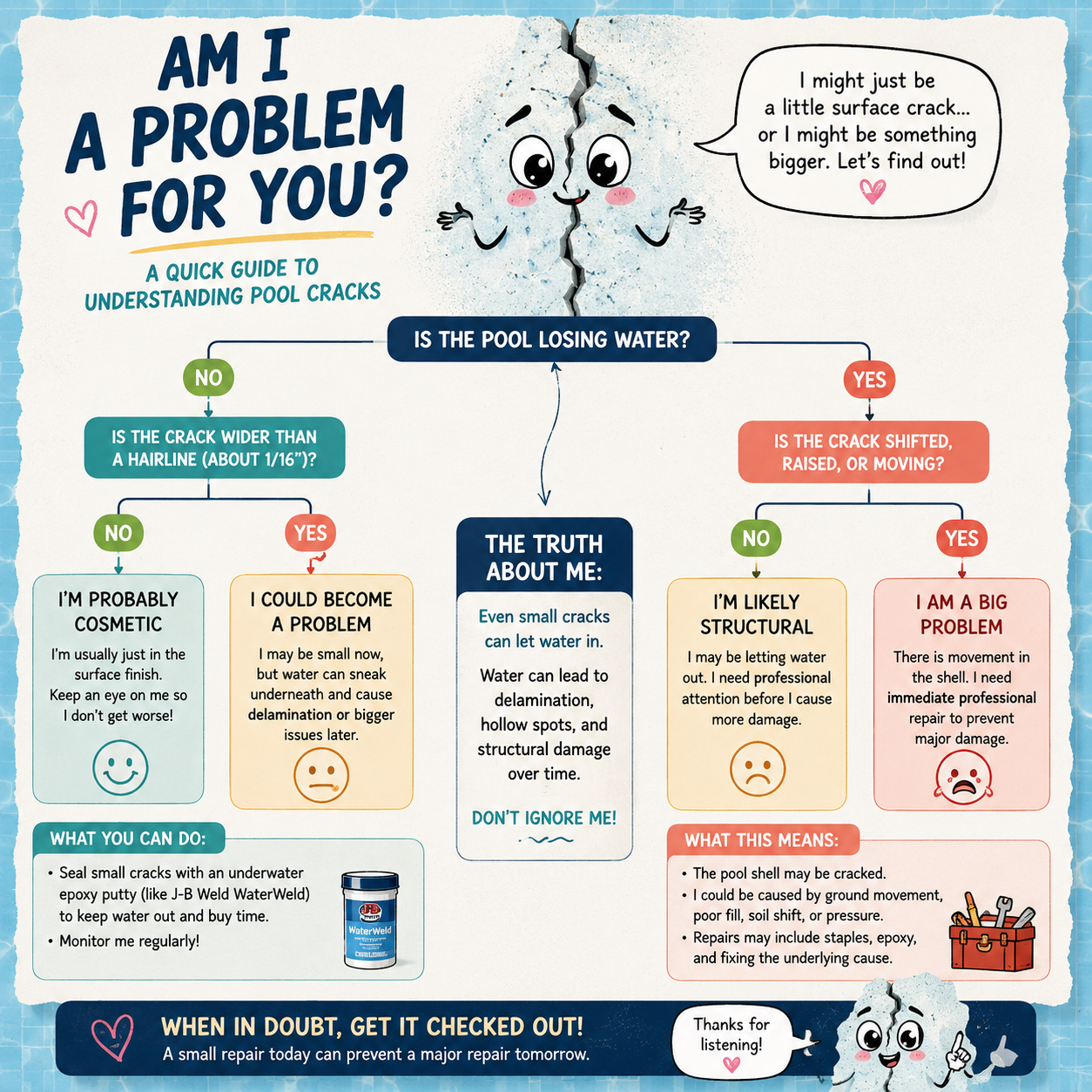
One of the most common questions pool owners ask is: "Is this crack serious?"
The answer is a little more complicated than yes or no.
Not every crack starts as structural. But almost every crack has the potential to become a bigger issue if water is allowed to penetrate beneath the surface.
That's the part many people miss.
Pools are layered systems. Even a small surface crack in marcite, plaster, or fiberglass can eventually allow water intrusion into the underlying shell structure. Once that happens, you can start seeing delamination, hollow spots, bond failure, moisture migration, surface lifting, and structural weakening over time.
So while a crack may begin as cosmetic, the long-term damage often is not.
The real goal is preventing water from turning a small repair into a major one.
Step 1: Identify the Crack Type
Before deciding on repairs, look at:
- Crack width
- Crack length
- Whether the pool is leaking
- Whether the crack is raised or offset
- Whether hollow areas exist nearby
- Whether the crack keeps returning
- Whether nearby decking or soil is moving
Those details help determine whether you are dealing with surface cracking, structural movement, or a combination of both.
Type #1: Surface or "Cosmetic" Cracks
What They Look Like
Surface-level cracks are usually thin hairline cracks, spider cracking, finish-only cracking, or small isolated cosmetic fractures in the topcoat or marcite. These commonly appear on steps or benches, around fittings, in older plaster, in sun-exposed areas, and in areas with repeated expansion and contraction.
At first, these cracks may not leak at all.
Why Cosmetic Cracks Still Matter
Even if the shell itself is still structurally sound, water can slowly migrate through the damaged finish layer. Over time, that moisture intrusion can weaken bond strength, create hollow areas, cause delamination, spread beneath surrounding surfaces, and create blistering in fiberglass systems.
This is why cosmetic cracks should not simply be ignored forever. The biggest thing is preventing water from getting deeper into the shell system.
Temporary Repairs Can Buy Time
Small surface cracks are often repairable temporarily before they become larger issues. In many cases, an underwater epoxy putty such as J-B Weld WaterWeld can be used to seal minor cracks and help prevent water intrusion. Products like this are widely available and can buy homeowners time before a larger resurfacing or repair project becomes necessary.
The goal of these temporary repairs is not necessarily permanent structural restoration. The goal is stopping water from penetrating deeper and starting delamination or bond failure beneath the surface. That distinction matters.
Quick Diagnostic Clues
Usually surface-level or cosmetic if:
- The crack is extremely thin
- No measurable water loss exists
- The surrounding shell feels solid
- No vertical displacement is present
- The crack remains stable over time
- No hollow areas are developing nearby
Still, monitoring matters. Small cracks rarely heal themselves.
Type #2: Structural Cracks
What They Look Like
Structural cracks involve movement through the actual shell of the pool. These cracks are more serious because the shell itself has been compromised. They may appear wider than hairline, long and continuous, through the floor or beam, across corners or transitions, or accompanied by movement or separation and active leaking.
Sometimes one side of the crack may sit slightly higher than the other. That is usually a major red flag.
The Biggest Warning Sign: Water Loss
If a crack is actively leaking water, the shell itself is usually cracked through its full path. That means the crack is no longer cosmetic, water is escaping through the structure, soil conditions around the shell may worsen, and further movement may continue occurring.
Most pools do not leak through purely cosmetic surface cracks alone. When active leakage is present, the structural shell is typically involved.
What Causes Structural Pool Cracks?
Most structural cracks are symptoms of movement — the crack itself is usually not the root issue. Common causes include:
- Improper soil compaction
- Poor fill beneath fiberglass pools
- Ground settlement
- Expansive soils
- Hydrostatic pressure
- Deck pressure
- Tree roots
- Washouts beneath the shell
- Long-term erosion
- Ground shifting
Florida soils can move more than many homeowners realize, especially in areas with inconsistent compaction or drainage problems. Fiberglass pools are especially sensitive to improper backfill conditions because unsupported areas can flex over time and create stress points in the shell.
Quick Diagnostic Clues
Usually structural if:
- The pool is actively losing water
- The crack repeatedly returns
- One side is shifted or raised
- Hollow areas exist nearby
- Multiple cracks branch outward
- Delamination surrounds the area
- The crack runs continuously through the shell
How Structural Cracks Are Repaired
Structural crack repair usually involves far more than simply filling the visible line — the shell itself has to be stabilized. A proper repair may involve:
- Grinding the crack open
- Pressure testing the shell
- Installing structural staples
- Epoxy injection
- Structural bonding
- Reinforcing surrounding material
- Rebuilding damaged areas
- Resurfacing the repaired section
The staples mechanically "button" the shell back together while epoxy helps restore structural integrity across the damaged area.
Critical: If the underlying movement is still occurring, the crack can return. That's why the root cause matters just as much as the visible repair itself. Repairing the symptom without addressing the movement is often temporary.
Why Delamination Often Follows Cracks
This is where small problems turn into expensive ones. Once water gets beneath the finish, moisture spreads, bond strength weakens, hollow areas form, and surface layers separate from the substrate. This process is called delamination.
You may notice hollow-sounding areas, bubbling, lifting surfaces, flaking, soft spots, or surface separation. In many cases, the crack itself was only the starting point.
When a Pool Crack Needs Immediate Attention
You should have the crack professionally evaluated if:
- The pool is actively leaking
- The crack is widening
- One side becomes raised
- Hollow areas develop nearby
- Surface material begins lifting
- The crack repeatedly reappears
- Surrounding decking shifts
- Soil erosion or washout becomes visible
The earlier movement-related issues are caught, the better the odds of preventing larger structural failures later.
Final Thoughts
Not every pool crack starts as a structural emergency. But every crack creates an opportunity for water intrusion if ignored long enough.
Sometimes a simple epoxy repair can buy valuable time and prevent deeper damage. Other times, the crack is warning you about movement occurring beneath the shell itself.
The important thing is identifying which type of crack you're actually dealing with before the damage spreads.
At Fibre Tech Inc., we approach pool cracks like structural diagnostics, not cosmetic coverups. Because long-term repairs start with fixing the cause, not just hiding the symptom.
If you're seeing cracks, hollow spots, or active water loss, request a free estimate and we'll assess what's actually happening beneath the surface.