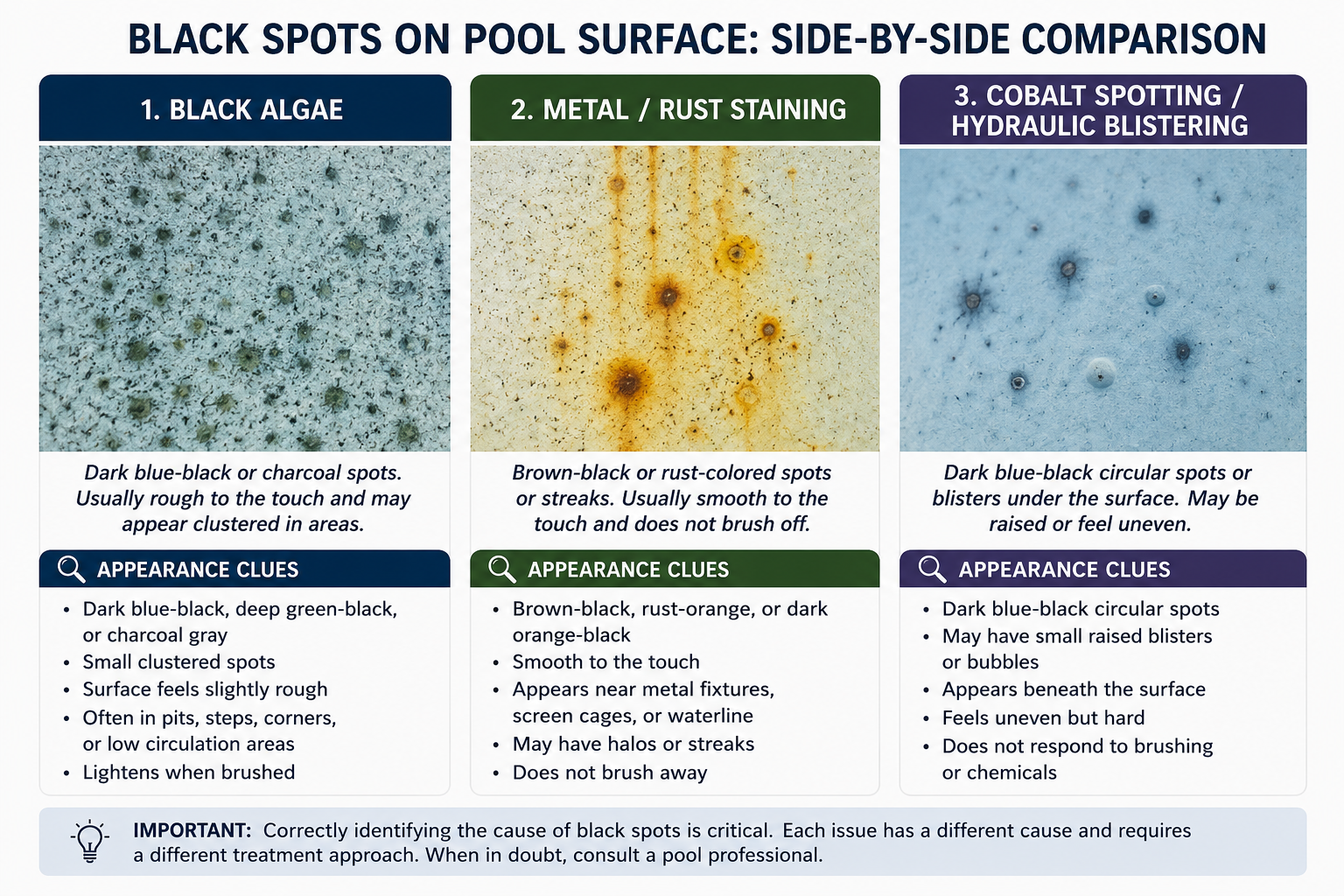
Not every black spot on a swimming pool surface is the same problem.
Some are biological growth. Some are metal staining. Others are signs of moisture-related surface failure beneath the coating itself.
The key is diagnosing the issue correctly before throwing chemicals, acid washes, or unnecessary repairs at the pool.
Think of this article like engine diagnostics for pool surfaces. We'll start with what the spots look like first, then walk through the likely cause and recommended treatment process for each condition.
Step 1: Identify the Appearance First
Before attempting treatment, pay attention to the following:
- Is the spot truly black or more blue-gray?
- Is it smooth or rough?
- Does it brush off?
- Is it raised or blistered?
- Is it isolated or widespread?
- Is it near metal fixtures or screen enclosures?
- Does it appear on the surface or beneath it?
- Are there tiny bubbles or pits forming?
Those details help narrow down the actual failure mode.
Common Cause #1: Black Algae
What It Looks Like
Despite the name, black algae is usually not pure black. It commonly appears dark blue-black, deep green-black, or charcoal gray — in small clustered spots. The surface may feel slightly rough or rooted into the finish.
Black algae often develops along steps, in corners, in low circulation areas, in older porous surfaces, and in etched or pitted plaster.
Unlike common green algae, black algae develops a protective outer layer that makes it resistant to normal sanitizer levels.
What Causes It
Black algae thrives when chlorine levels are inconsistent, water circulation is poor, organic debris accumulates, or pool surfaces become porous with age. Older marcite and cement-based finishes are especially susceptible because they naturally become more porous over time. Florida heat and UV exposure accelerate this aging process.
Quick Diagnostic Clues
Usually black algae if:
- The spot feels slightly rough
- Brushing temporarily lightens it
- Multiple spots appear together
- The issue keeps returning after shocking
- Spots form in pits or etched areas
Treatment Process
- Aggressively brush the area using a nylon pool brush
- Raise free chlorine levels significantly
- Maintain proper stabilizer levels
- Use a targeted black algae treatment if necessary
- Improve filtration and circulation
- Address underlying surface porosity if the issue keeps returning
Important: If the pool surface has become heavily porous or etched, algae may continue returning because the organism embeds deep into the finish. In severe cases, resurfacing becomes the permanent solution.
Common Cause #2: Metal or Rust Staining
What It Looks Like
Metal staining is one of the most commonly misdiagnosed pool surface issues. It may appear brown-black, rust-colored, dark orange-black, or as thin dark streaks or circular stains near metal fixtures. These stains are usually smooth to the touch and do not brush away easily.
In Florida, screen cages are a common source. Corroding screws, fasteners, and aluminum components can introduce trace metals into the water over time. Well water and high iron content can also contribute.
What Causes It
Typical sources include rusting screen enclosure hardware, iron in fill water, fertilizer overspray, corroded handrails, metal debris left in the pool, and equipment corrosion. Once oxidized, metals can chemically bond to the pool surface and create stubborn dark staining.
Quick Diagnostic Clues
Usually metal staining if:
- The spot feels smooth
- Brushing does nothing
- There are brown or orange undertones
- The staining appears near metal fixtures
- Vitamin C testing temporarily lightens the stain
- The stain follows water runoff patterns
Treatment Process
- Identify the metal source
- Perform stain testing to confirm diagnosis
- Apply an appropriate stain remover or ascorbic acid treatment
- Add a quality sequestrant to bind dissolved metals
- Correct water chemistry
- Eliminate the source of contamination to prevent recurrence
Important: Acid washing may reduce the appearance temporarily, but it does not solve the underlying metal contamination issue.
Common Cause #3: Hydraulic Blistering
What It Looks Like
This condition is less common but often confused with algae or staining. Hydraulic blistering may appear as dark blue-black circular marks, small raised blisters, tiny bubbles beneath the finish, or isolated dark spots that do not brush away. Unlike algae, the discoloration usually appears embedded beneath the surface layer itself. Some areas may eventually rupture or form small craters.
What Causes It
Hydraulic blistering occurs when moisture pressure builds beneath the surface coating. Potential causes include moisture vapor transmission, osmotic pressure, improper substrate preparation, trapped contaminants, poor lamination conditions, and water intrusion behind the coating.
In some fiberglass systems, improper resin curing or cobalt accelerator migration can contribute to dark discoloration near blister sites. This is a substrate or coating issue — not a water chemistry issue. Chlorine treatments will not solve it.
Quick Diagnostic Clues
Usually hydraulic blistering if:
- The spot appears beneath the surface
- Tiny blisters or bubbles are present
- Chlorine treatment has no effect
- The area feels uneven but hard
- The spots worsen over time
- The issue appears random rather than clustered
Treatment Process
Minor isolated defects may sometimes be repairable locally. More widespread blistering may require:
- Grinding affected areas
- Moisture remediation
- Proper substrate preparation
- Re-lamination
- Full surface refinishing
This is why preparation and material selection matter during resurfacing. A premium finish system is only as good as the substrate beneath it.
When Black Spots Mean the Surface Is Failing
Dark spots are often symptoms rather than the root problem. If your pool surface is rough, porous, constantly staining, repeatedly growing algae, blistering, delaminating, or difficult to chemically balance — the finish itself may simply be reaching the end of its service life.
Older cementitious finishes become increasingly porous over time, which creates a cycle of algae retention, staining, and chemical instability.
Final Thoughts
Not all black spots are equal.
Treating metal staining like algae wastes money. Treating hydraulic blistering with chlorine wastes time. And acid washing everything blindly can sometimes make the problem worse.
Correct diagnosis comes first.
At Fibre Tech Inc., we approach pool surface issues the same way a mechanic approaches engine diagnostics: identify the failure mode first, then recommend the correct repair path. Because the right repair starts with understanding what you're actually looking at.
If your pool has recurring black spots, staining, or a surface that's becoming harder to maintain, request a free estimate and we'll tell you exactly what you're dealing with.